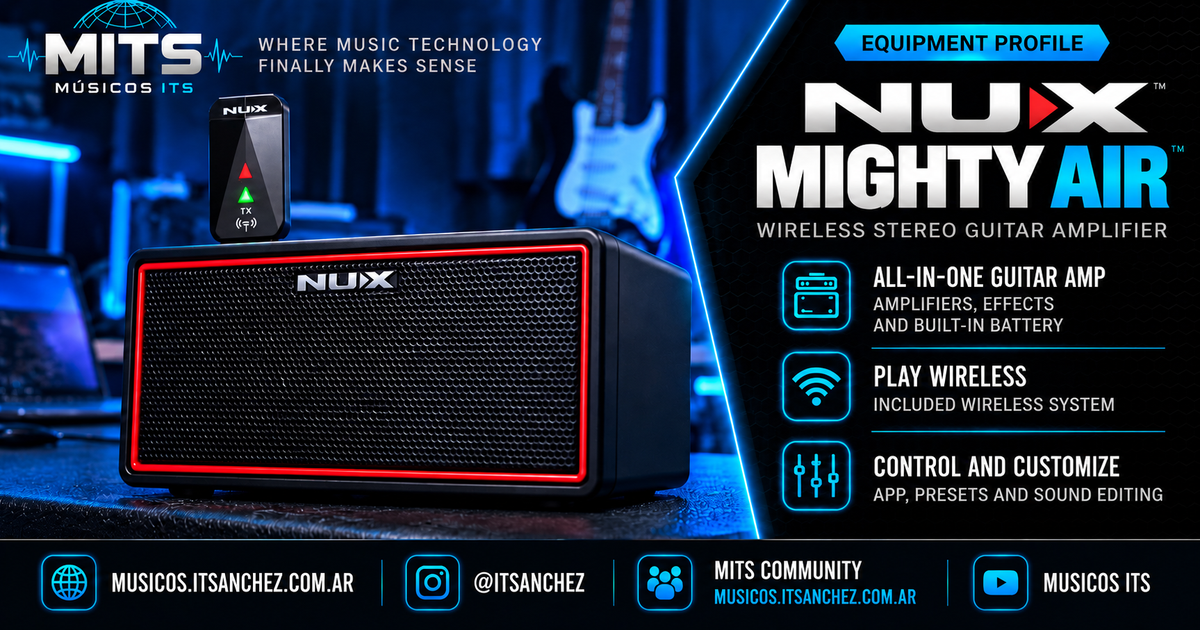
¶ NUX Mighty Air
The NUX Mighty Air is a compact stereo modeling amplifier for guitar and bass, designed primarily for practice, personal use and portability.
It combines amplification, effects, IR-based cabinet simulation, Bluetooth connectivity, a rechargeable battery and a wireless system for your instrument.
Its concept is simple: turn it on, connect your guitar and start playing without having to set up a complete chain of gear and cables.
At MITS, we don't analyze the Mighty Air based only on its specifications. We've been using this amp for years, so this profile combines technical information with real-world, long-term experience.
¶ Main Specifications
| Feature | Specification |
|---|---|
| 🔊 Speakers | 2 × 2-inch speakers |
| ⚡ Output Power | 4 W × 2 |
| 🔋 Playing Time | Up to 18 hours |
| 🔌 Battery | Rechargeable long-life battery |
| 🎸 Instruments | Electric guitar and bass |
| 📡 Wireless System | NUX transmitter included |
| 📱 Control | MightyAmp app |
| 🔵 Connectivity | Bluetooth |
| 🎛️ Processing | Amp modeling + effects |
| 🔊 Cabinet Simulation | IR |
| 🎧 Format | Compact stereo amplifier |
NUX officially specifies two 2-inch speakers, 4 W × 2 output power, up to 18 hours of playing time and a rechargeable long-life battery.
¶ An Amplifier Designed for Wireless Playing
One of the most interesting features of the Mighty Air is that the wireless system is an integral part of the amplifier's concept.
The amplifier has a built-in receiver and comes with a NUX wireless transmitter that connects directly to your instrument.
This makes the setup extremely simple:
Guitar → Wireless Transmitter → Mighty Air
No instrument cable is required between the guitar and the amplifier.
The system can be used with guitar or bass, and NUX specifies compatibility with instruments equipped with both passive and active pickups.
¶ Stereo Speaker System
The Mighty Air features:
- 2 custom 2-inch speakers
- 4 W + 4 W output power
- stereo operation
- passive radiator to enhance bass response
Using two speakers makes it possible to take advantage of stereo effects and provides a much wider spatial experience than you might normally expect from a practice amplifier of this size.
The passive radiator also helps extend the low-frequency response, which is particularly important considering the amplifier's compact dimensions.
¶ Amplifier Modeling
The Mighty Air uses NUX modeling technology.
With Firmware V2, NUX updated its modeling using the TSAC-HD White-Box algorithm.
The purpose of this system is to model not only a static amplifier response, but also part of the dynamic behavior and feedback characteristics found in traditional amplifiers.
From the app, we can select different models and build our own sounds by combining:
Amplifier → Cabinet/IR → Effects
¶ Impulse Responses — IR
The Mighty Air uses Impulse Responses (IR) for cabinet simulation.
NUX specifies a resolution of:
512 samples
The amplifier includes different types of IRs.
¶ Guitar Cabinets
- 1960A
- A212
- BS410
- DR112
- GB412
- JZ120
- TR212
- V412
¶ Bass Cabinets
- AGL_DB810
- AMP_SV810
- MKB_410
- TRC_410
¶ Acoustic Guitar Simulation
The Mighty Air also includes IRs designed to simulate acoustic guitars when using an electric guitar equipped with magnetic pickups.
These include:
- G HBird EG Mag
- G J15 EG Mag
- M D45 EG Mag
- G J200 EG Mag
- G J45 EG Mag
- T 314 EG Mag
- M HD28 EG Mag
¶ Built-in Effects
The Mighty Air includes a complete effects processing chain.
¶ Pre-EFX
Available effects include:
- Touch Wah
- U-Vibe
- Tremolo
- PH 100
- ST Singer
- T Screamer
- Katana
- 3 Band EQ
- Muff Fuzz
- Crunch Box
- Red Dirt
- Morning Drive
- Dist One
- Rose Comp
¶ Modulation
- PH 100
- CE-1
- ST Chorus
- SCF
- U-Vibe
- Tremolo
¶ Delay
- Analog
- Digital
- Mod Delay
- Ping Pong
¶ Reverb
- Room
- Hall
- Plate
- Spring
¶ Noise Gate
The processing chain also includes a Noise Gate.
This is particularly useful with higher-gain configurations or when using the wireless system in environments where interference or noise may be present.
The Gate can be adjusted as part of the sound configuration.
¶ MightyAmp
NUX provides the MightyAmp app for controlling and editing the amplifier from mobile devices.
It is officially available for:
- iOS
- Android
From the app, we can access the Mighty Air's amplifier models, IRs, effects and parameters.
We can also save configurations for later use.
¶ Bluetooth
Bluetooth on the Mighty Air serves different purposes.
First, it allows the amplifier to be used as an audio playback system.
This makes it possible to play:
- songs
- backing tracks
- study material
- practice tracks
while playing guitar at the same time.
Bluetooth is also used for communication with the MightyAmp app, where we can edit the amplifier's sounds.
¶ Player and Practice Features
The built-in player also provides 9 EQ presets.
One of them is a feature called Guitar Cut, designed to reduce the presence of the guitar in certain songs and make it easier to practice along with the original track.
The result naturally depends on how the original song was mixed, but it can be a useful practice tool.
¶ Up to 18 Hours of Playing Time
One of the Mighty Air's strongest features is its battery life.
NUX specifies up to 18 hours of continuous playing time on a single charge.
The amplifier features a rechargeable long-life battery, eliminating the need for AA batteries.
Combined with the wireless transmitter, this allows the amplifier to be used without constantly depending on an external power source.
¶ What Is It Designed For?
The Mighty Air is particularly useful for:
- home practice
- personal use
- lessons
- warming up before playing
- travel
- practicing with backing tracks
- guitar
- bass
In practice, its main advantage is minimizing everything required to start playing.
There's no need to set up a pedalboard, audio interface, monitors and cabling every time you want to practice.
¶ How We Use It at MITS
At MITS, we've had the NUX Mighty Air for several years.
This isn't a piece of equipment that arrived just for a test or review.
It's part of our gear and continues to have a specific role: practice, lessons and situations where we simply want to connect the guitar and start playing quickly.
Even with modelers, audio interfaces and other amplification systems available, the Mighty Air remains useful precisely because it solves a different problem:
minimizing the time between picking up the guitar and actually starting to play.
That long-term experience is also the basis of our analysis of the amplifier.
¶ Mighty Air in 2026
The Mighty Air has been on the market for several years, but its features remain interesting for a compact practice amplifier:
- wireless operation
- built-in battery
- up to 18 hours of playing time
- stereo audio
- Bluetooth
- amplifier modeling
- effects
- IR
- editing app
- guitar and bass support
That's why at MITS we're interested in answering one specific question:
Is the NUX Mighty Air still worth it in 2026?
Not just from a list of specifications, but after several years of actually using it.
¶ MITS Video
In our video, we take a look at the Mighty Air from a long-term, real-world use perspective.
We'll show how we use it, some of our sounds, its wireless operation and the tools we still use with the amplifier today.
NUX Mighty Air in 2026: Is It Still Worth It? + macOS APP
The purpose of this profile is to complement the video with technical information, configurations and resources that we can reference and update over time.
¶ Official Resources
For specifications, firmware, manuals, applications and documentation, we recommend always checking the manufacturer's official sources.
¶ 🌐 Official NUX Mighty Air Page
https://nuxaudio.com/product/mightyair/
On the official NUX website you can find:
- complete specifications
- firmware
- manuals
- MightyAmp app
- manufacturer documentation and resources
The technical specifications included in this MITS Equipment Profile were checked against information officially published by NUX.
¶ MITS Resources
This page is part of the MITS Equipment Profiles.
As we continue working with the Mighty Air, we'll add:
- configurations used at MITS
- presets
- practical tests
- procedures
- compatible applications
- related material
- new videos
At MITS, our goal is to understand how the equipment works and how to use it in real-world situations, rather than simply listing its specifications.